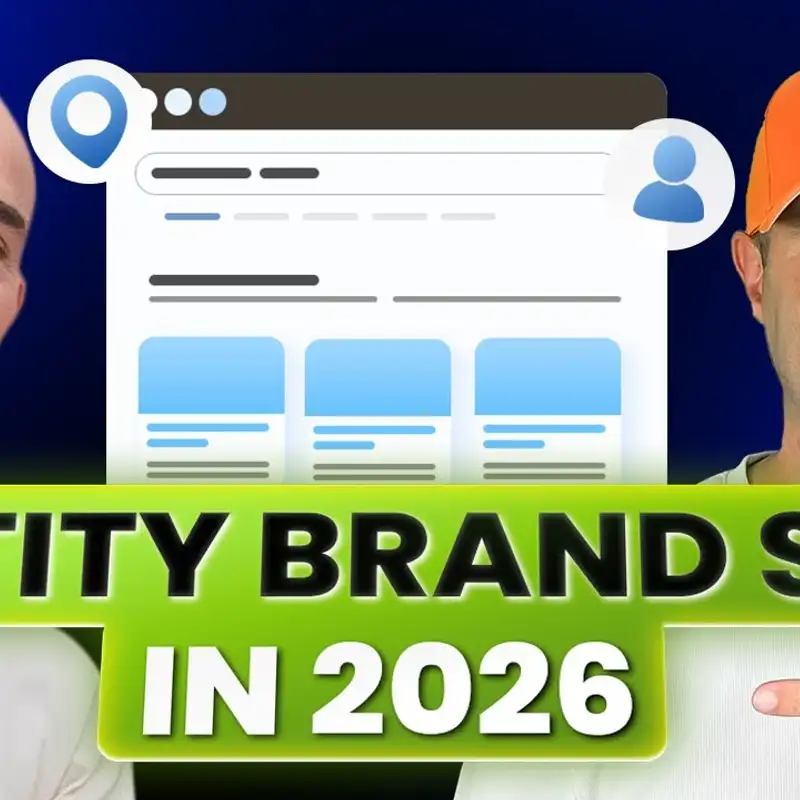
Entity Brand SEO in 2026 (James Dooley Discusses with Luis Salazar Jurado)
James Dooley: Hi, today I’m joined with Luis Salafar Herado and today’s topic is about entity brand SEO in 2026. Is it important? Is it not important? What different kind of benefits are you going to get with now trying to make certain that you’re concentrating on your entity and your brand as part of your SEO strategy? So, Luis, take it away.
Luis Salafar Herado: First of all, thank you for having me. Second of all, it’s not something new that brand searches are getting more and more important. You have to connect your brand with the entity and then communicate that across the internet, so Google understand what you are, what you do, what’s your audience and what you sell.
Luis Salafar Herado: In order to connect the entity, or make clear what your entity or your brand is about, you have to provide all the attributes related to your brand. You have to communicate that across the internet with third party sources, social media profiles, press releases, and so on. That connects all the dots and creates the relationships, because at the end of the day you are feeding a bot, so it can understand the information about your brand that is gathered in the Knowledge Graph.
Luis Salafar Herado: The better you structure, communicate, and organise the information not only on your site but across the whole internet, the better. You need a strategy for communicating your brand values, brand awareness, brand recognition, and third party validation. If nobody knows you as a brand and nobody searches for you, how is Google going to rank you? How is Google going to understand what you do, what you sell, who your customers are? If you do not show up anywhere on the internet, how important can you be?
Luis Salafar Herado: You are not popular. Nobody knows about you. Nobody searches about you. That is the key now if you want to rank better, rank faster, and rank higher. On top of that, you have to compete in more verticals because AI is now everywhere. You have to show up in AI Overviews and other AI interfaces. If you are not in the model, you are not in the game. If Google do not have information about you, and cannot compare and contrast it in third party sources, there is no corroboration, no consensus, and no validation. You are not in the game, because you are not in the LLM. If you are not in the LLM, you are not in AI Overviews. You are not in AI answers.
Luis Salafar Herado: Your brand should be the primary focus. You have to get all the pieces of the puzzle together, put the pillars, and grow from there. To do that, you need your Knowledge Graph. You have to get your KGM ID, and you have to organise information to fit the bot, so all that information is accurate.
Luis Salafar Herado: I’m going to give you an example. Imagine James Dooley. James Dooley is an entrepreneur, among other things. All the information on the internet has to validate James Dooley is an entrepreneur. I’m going to use an analogy. You want to buy a business. The business is the entity. The name of the business is the entity. Then, as an entrepreneur, you do the due diligence. The due diligence is the bots coming to your site, crawling your site, and getting all the information.
Luis Salafar Herado: From a business perspective, you analyse debt, cash flow, margins, assets, liabilities, and so on. All those variables are the attributes about the entity, and the entity is the business you want to buy.
Luis Salafar Herado: Using that analogy, when you want to rank for your brand, your brand has a name. It is an entity. You have to provide all the attributes, which are the variables that contain information about your brand. The due diligence is the bot crawling you. But only studying and researching the financial statements is not enough. You also need research. You need to contact people. If you do proper research, you talk to former employees, you talk to the banks, you talk to lawyers. That is the third party validation.
Luis Salafar Herado: Using the SEO analogy, bots come, get the information about the brand, but then Google also visit your social media profiles. Google analyse your reviews, citations, press releases, and so on. When Google get all that data, if Google trust you enough, it is going to rank you.
Luis Salafar Herado: In the same analogy, if you want to buy a business, and all that data is trustworthy enough, you buy that business. To rank with your brand, you have to be trustworthy. People have to search for your brand. Your data has to be accurate and consistent across the whole internet. That gives trust. People search for you. People buy your products or services.
James Dooley: I want to stop you on this and go through this, because that was a brilliant analogy. I love everything you went into, and I’ve got a million questions now. What I love about that analogy is if some numbers were not correct, my confidence drops. If they do not know their numbers, what else do they not know? What else is lacking? So I might not invest. Google’s confidence score needs to be high to trust you to rank you. So I love that analogy.
James Dooley: We are in 2026 now. A lot of people understand branding is important. Branded clicks, branded mentions, branded anchor text. Everyone’s talking about brand and branding. But entities, not many people talk about entity SEO.
James Dooley: You expanded on the Knowledge Graph. You spoke about what Jason Barnard talks about, the algorithmic trinity. That is making certain you have a Knowledge Panel and it has a high confidence score in the Knowledge Graph. That’s one part. The second part is Google rankings, normal website rankings. The third one is artificial intelligence, so ranking in Claude, Perplexity, Gemini Overviews, and getting into those LLMs. That’s what Jason Barnard calls the algorithmic trinity.
James Dooley: On the Knowledge Graph specifically, you spoke about a KGM ID. For anyone that doesn’t know, it stands for Knowledge Graph Machine ID. Am I right in saying if your website or your brand doesn’t have a KGM ID, Google doesn’t even know you as an entity? You are only an entity when you have a KGM ID. Is that correct?
Luis Salafar Herado: Absolutely. You’re totally right. I’m going to use an offline example. Each one of us has a number. A phone number is an ID. We all have a passport number. That passport number is an ID. Each country has an identity card, which is a number. All those numbers are IDs about ourselves.
Luis Salafar Herado: We are the same entity, person entity, but we have different identifiers. The phone number, the identity card, and the passport number. All those numbers connect to the same entity.
Luis Salafar Herado: Each brand, each entity on the internet has an identifier. As you mentioned, it is the KGM ID. If you launch a site, if you launch a brand, but Google do not have that KGM ID, Google do not know who you are. Google create an identifier for each entity on the internet. If you don’t know your own identifier, you cannot connect with Google. Google knows who you are, but you don’t know your own number.
Luis Salafar Herado: It’s like someone asks you for your phone number and you don’t know it. How are you going to connect? Technically, you have to create a way to connect with the Knowledge Graph API. That is nothing more than a number, an identifier. You are connected to the universal data, the internet. If not, you are an isolated entity. If you are isolated, how is Google going to know about you?
James Dooley: Anyone watching this, we’re going to do a whole podcast series around entities and branding and KGM IDs. We’re going to go deeper into how you trigger a KGM ID, how you improve the confidence score, how you identify your KGM ID number, and how you avoid having two or three, because Google can create multiple KGM IDs if it’s not certain it is the same entity.
James Dooley: I had three different KGM IDs because I had podcasts, books, and digital PR signals. It created multiple identifiers, like multiple telephone numbers, and I had to sort it out. I didn’t even know I had that problem until I understood the importance of the Knowledge Graph for my personal entity. If I don’t know what it is, how can I expect Google to understand what it is?
James Dooley: I want to expand on schema. I’ve seen videos saying schema is not a ranking factor, and you don’t need schema and JSON-LD. I used to think that years ago and now I’m laughing at the people saying schema is not important, because I’m starting to understand how important it is to tell Google that this James Dooley is this KGM ID, this James Dooley is this Facebook page, this James Dooley is this Twitter account, because there is more than one James Dooley.
James Dooley: There’s only one KGM ID for me. I need to differentiate myself. I need to say this is the James Dooley that I want connected in this bucket. This is who I am. This is what I do. I’m not the musician. I’m the entrepreneur that invests in companies and does lead generation for companies in the UK. This is me, and this is what I want you to know about me.
James Dooley: Can you explain how important JSON-LD and schema is for those connections and that confidence score? In my opinion schema is the glue that connects everything together properly.
Luis Salafar Herado: It’s very important. First, schema is a standard created in 2011, if I remember correctly, by Google, Bing and other search engines. It’s something the biggest search engines agreed upon long time ago.
Luis Salafar Herado: Second, it is machine readable information. It is the fastest, cheapest, and most efficient way to communicate with a machine. Third, it is a standard. The more people use it, and the more granular and accurate you design the JSON and the more precise you program it, the more accurate information you provide.
Luis Salafar Herado: As you mentioned, there are a lot of James Dooleys in the world. The way you disambiguate who you are is with the KGM ID plus accurate unique information about yourself. You can communicate, corroborate, consolidate, and create consensus all over the internet. The fastest, cheapest, and most efficient way to communicate is with JSON-LD.
Luis Salafar Herado: Why? Because the bot does not have to crawl the whole site. It comes to the site, checks if there is JSON. If there is, it gets the JSON and leaves. All that information is structured. The more granular and better organised, the better.
Luis Salafar Herado: It is the fastest way for the machine to understand who you are. You provide your KGM ID, you provide information to disambiguate James Dooley entrepreneur from another James Dooley. You control the message, you control the data, and you control the connections. You have the power. JSON-LD is the glue that puts all the pieces together and communicates with a machine.
Luis Salafar Herado: At the end of the day, it is semi-automated. There is no human checking if the information is correct or not. Bots gather data, test, check, and digest information to make sure it is accurate.
Luis Salafar Herado: You can design your own message to the machine with JSON-LD based on unique information. You have the power to communicate that information. The better you design it and the more granular you make it, the better.
Luis Salafar Herado: It also helps from a reputation management perspective. Nobody can easily fake that information. They can try, but if you give the information to Google first, and it is in historical data, you are first. You win the race.
James Dooley: I was writing some notes. I love the terms you used. Cheapest, fastest, machine readable. Corroboration on third party sources. For me the main three terms are disambiguation, clarity, and confidence. If you get clarity right, Google becomes confident they understand exactly who you are. When they are confident, they can trust you.
James Dooley: People use the word trust from a brand, but a lot of that comes back to clarity and confidence. How confident are they at understanding who you are and what you do? When they understand that, and it’s backed up on third party sources, that confidence score increases.
James Dooley: We’ve done a video on why backlinks now have evolved beyond PageRank and link juice. Backlinks now also extend your semantic content network across third party sources, repeating and validating who you are and what you do. It builds confidence in the algorithms.
James Dooley: Is there anything else you can add on schema before I move on?
Luis Salafar Herado: Yes. Disambiguation is very expensive for Google. The bigger the internet, the more entities they have to crawl, understand, and digest. The more expensive it is for the algorithm to process, organise, and connect that data.
Luis Salafar Herado: The more granular and accurate you are with JSON-LD, the cheaper, faster, and easier it is for Google to understand you. That is a competitive advantage, because every day there are new brands and new sites, and a lot of information to crawl.
Luis Salafar Herado: If people want to expand on this, they can search for Google’s report called The Messy Middle. Disambiguation is costly. When Google is not sure between A, B, C, the algorithm is deciding.
Luis Salafar Herado: I’ll use an example, John Smith. John Smith is a common name. There are a lot of John Smiths. If you type John Smith, Google doesn’t know which John Smith you want. You need another word to add an attribute and narrow down the dataset. That logic applies to JSON-LD too. You design JSON-LD with your KGM ID, provide granular data, and you feed the bot.
Luis Salafar Herado: Then third party corroboration and backlinks make it sticky. Google cannot trust one single source. It needs many sources. It is the same as humans. You don’t trust a person after one interaction. Trust takes time, and often comes through recommendation.
Luis Salafar Herado: Before the internet, you trusted a butcher, mechanic, electrician through word of mouth. Online, it is faster because of algorithms, but the principle is the same. Google needs many sources to trust you. The more accurate and granular the information, the better.
James Dooley: I love that point. People pigeonhole semantic SEO as just attributes, facets, topical maps, and semantic content networks. But we’re talking about branding, entities, KGM IDs, schema, backlinks, branded searches. Your community understands the whole game. It’s not just content on a website. It’s off page signals, trust building, and omnipresence.
James Dooley: If someone just builds a topical map and semantic content network and tries to build topical authority, how much easier does it rank when you add corroboration, branding, and backlinks? How important is it for people to understand it is not just about topical authority?
Luis Salafar Herado: I’ll use an analogy. You want to solve a puzzle. You need all the pieces and you need to organise them in the right order. A topical map alone does not solve the puzzle. Backlinks alone do not solve the puzzle. JSON-LD alone does not solve the puzzle.
Luis Salafar Herado: Ranking your brand and building trust is the whole puzzle. You need the right strategy, in the right order, executed properly. You are competing with brands doing the same. It is a match of data, and Google chooses who deserves to be on top.
Luis Salafar Herado: Another analogy is football. In the Premier League, teams compete. They have great players. Positions change because sometimes you win, sometimes you lose, sometimes a stronger team has a bad day. Rankings behave similarly. Sometimes you are first, sometimes third, sometimes second. User clicks move the needle.
Luis Salafar Herado: To be competitive you have to tick all the boxes. One player cannot win a match. One variable cannot win rankings. The online game is 24/7. If you stop, you lose. Google updates are like a referee. Google decides who is on top, based on evaluation over time.
Luis Salafar Herado: The summary is a holistic approach. Execute the plan strategically and intelligently. Balance resources to win the match, and win the competition.
James Dooley: For anyone watching, this is the first part in a series about brand SEO in 2026, entity SEO in 2026, and KGM SEO in 2026. Leave a comment with what questions you want me to ask Luis. It could be triggering KGM IDs, improving Knowledge Graph confidence score, identifying your KGM ID, or advanced schema strategies. Luis, it’s been an absolute pleasure, and we’ll see you again soon.
Luis Salafar Herado: Right back.
Creators and Guests